

Almost every renovation-scam guide gives you the same job: learn to spot the bad contractor. Watch for the red flags, read the reviews, check the company is real, and trust your gut.
Here is the uncomfortable part. In 2026, homeowners who did exactly that are still losing their deposits. The scammers got better at looking legitimate, and the system for getting your money back barely works. Spotting the scammer is no longer the game. Protecting your money is.
This is a full 2026 update of our renovation-scams guide. We have kept what still works, thrown out what no longer does, and reorganised the advice around one idea: stop relying on your judgement of a stranger, and start making your money structurally impossible to steal. Home Reno Pte Ltd is a CaseTrust and RCMA accredited renovation company that has worked in Singapore since 2007, and we will be specific about why accreditation is the lever that actually matters here.
Quick Answer: How Do You Avoid A Renovation Scam In Singapore In 2026?
You cannot reliably tell a scammer apart from an honest contractor by how they look or sound anymore. So do not try to win on judgement. Win on money structure:
- Engage a CaseTrust and RCMA accredited firm, because accreditation forces a deposit performance bond and a standard contract that let you claim back unused prepayments if the company folds or disappears.
- If the firm is CaseTrust accredited, confirm that the initial deposit is no more than 20 percent and that the payment is protected.
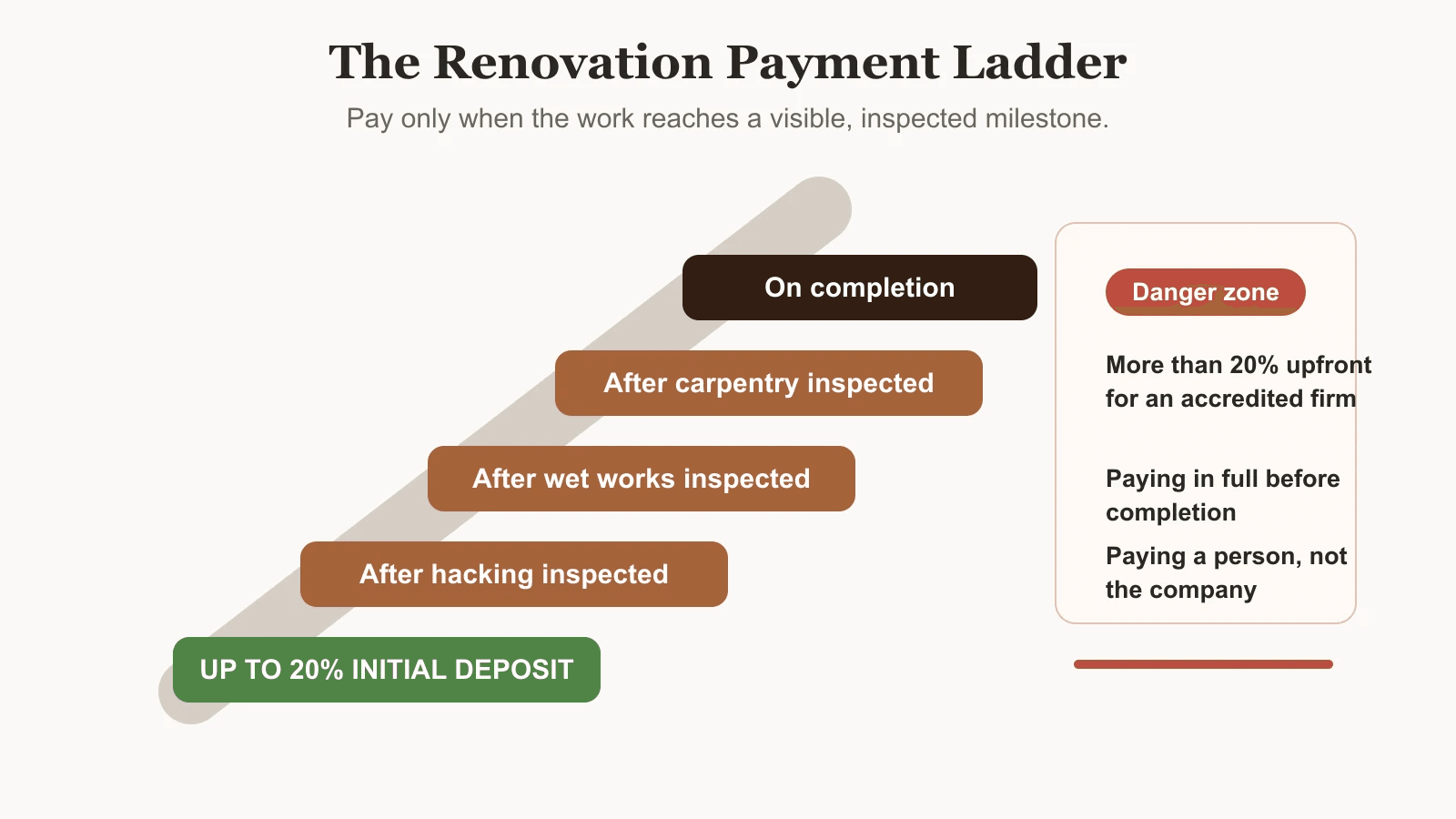
- Pay progressively, against work you have inspected, never in full and never in advance.
- Pay the company through traceable means, never a salesperson personally, and always collect an official receipt.
Everything else, the reviews and the portfolio and the polished showroom, is supporting information. It is not your protection. The four points above are.
The Uncomfortable Truth: Doing Your Homework Is No Longer Enough
The numbers from 2024 are not improving. The Consumers Association of Singapore (CASE) received 962 renovation-related complaints that year, with around S$728,000 in prepayment losses. About 97 percent of those complaints involved firms that were not CaseTrust accredited.
Now look at what happens after you are cheated. The Small Claims Tribunals only hear disputes up to S$20,000, and even a tribunal order is only worth something if the company still has money or assets. Many do not. In the renovation cases CASE handled, only around four in ten reached a resolution, and of the cases that stalled, almost a quarter of homeowners simply gave up. The Government confirmed its position in Parliament in February 2025: there is no mandatory licensing scheme coming for renovation contractors. The safety net is the accreditation framework, and it only protects the homeowners who actually choose it.
Put those two facts together and the conclusion is blunt. Prevention is not the best protection, it is almost the only protection. Once your money has left your hands to the wrong firm, no tribunal can reliably get it back for you.
Why The Old Advice Is Quietly Failing
The classic checklist was written for the old scam: a dodgy shop with a cheap quote and an evasive manner. That scammer still exists, but the ones taking the most money in 2026 do not look like that at all.
They look more legitimate than the honest firms
A convincing Instagram or TikTok page, a slick portfolio, and a wall of five-star reviews now cost almost nothing to manufacture. Renders can be lifted from other projects or generated outright. “Looks professional” has stopped being evidence of anything.
They come to you, at your weakest moment
In one case investigated by the Police, a contractor went door to door promoting his services, then went uncontactable once payments came in. He was linked to more than 20 cases islandwide and over S$198,000 cheated. The pattern repeats around BTO key collection, when first-time owners aged 25 to 35 in towns like Punggol, Sengkang, and Tampines are standing in an empty flat with a move-in deadline and an attractive quote in hand.
They can pass your background check and still disappear
This is the one that catches careful people. A company can be properly registered with ACRA, show a tidy set of reviews, and still be a shell. When the bad reputation builds up, some operators simply wind down and reopen under a new name, a fresh ACRA registration with the same people behind it. A clean search result tells you the entity exists. It does not tell you the deposit you are about to hand over is safe.
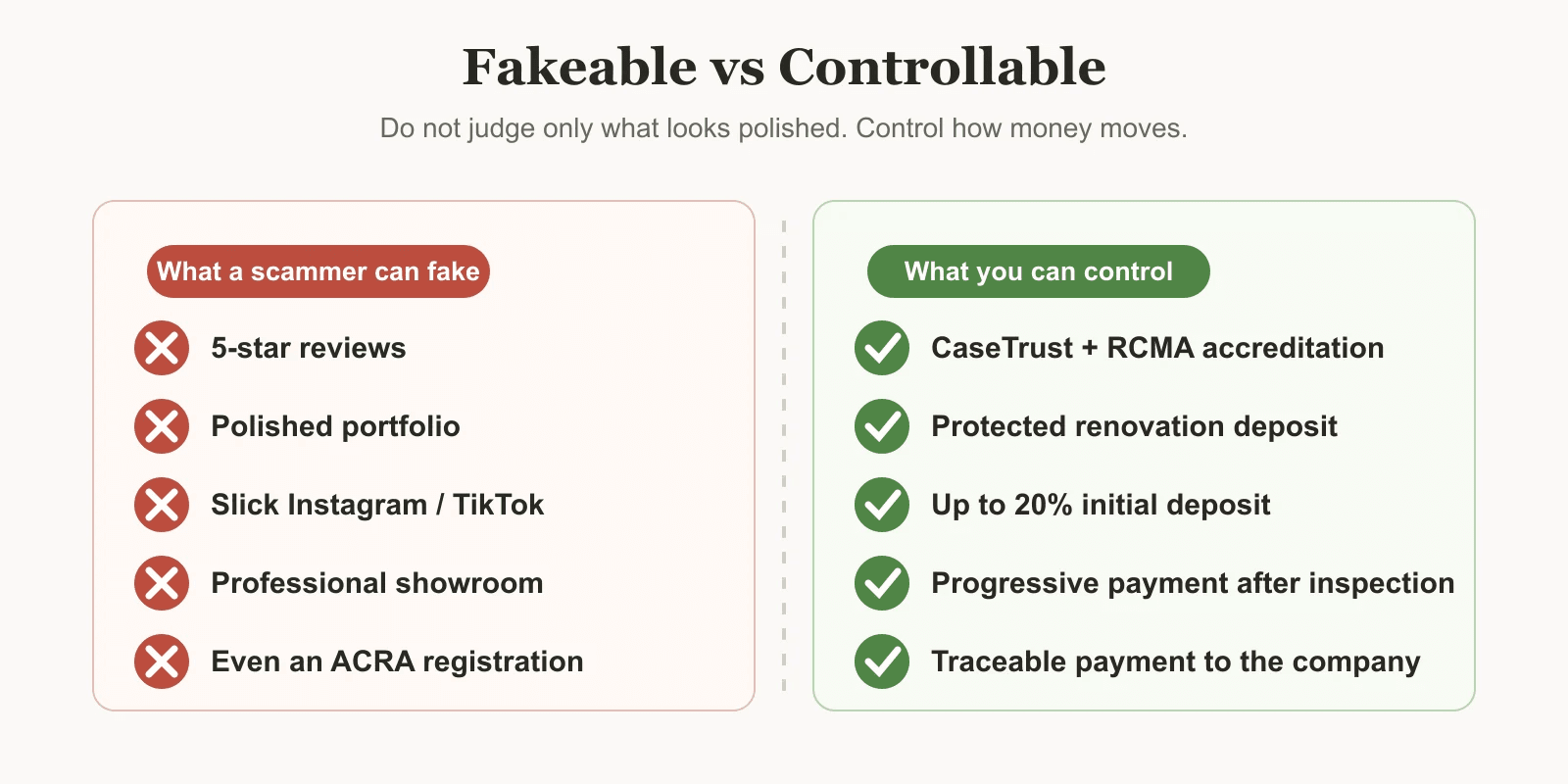
Protect The Money, Not Your Read On The Person
Here is the reframe. Instead of asking “can I trust this firm?”, which depends on a judgement that scammers are paid to defeat, ask “if this firm turned out to be dishonest tomorrow, how much could it actually take from me?” Drive that answer to as close to zero as possible. There are four levers.
1. Make your deposit recoverable, not just small
A CaseTrust and RCMA accredited firm is required to protect your deposit with a deposit performance bond and to use the CaseTrust Standard Renovation Contract. In plain terms, that protection lets you claim back the unused portion of a protected prepayment if the accredited business closes. CASE currently states that the initial deposit for an accredited renovation business is capped at 20 percent of the total cost. After paying, you should receive proof of protection showing your details and the protected sum. Review the current CaseTrust renovation protections before you sign.
2. Stage every payment against work you have verified
Tie each payment to a completed, inspected milestone. Before you release any progressive payment, visit the site and confirm the work is actually done to standard. Never agree to pay in full before completion, and be on high alert the moment a contractor leans on a “cashflow problem” to ask for money in advance of work. That single line is the most common script in stalled-renovation cases. Honest firms work to a progressive schedule because the accredited contract requires it. Scammers want the money ahead of the work, because the money is the work.
3. Keep the money traceable, and pointed at the company
Pay by crossed cheque or cashier’s order made out to the company, not by cash and not by transfer into a salesperson’s personal account. Collect an official receipt at the point of every payment, not afterwards. If anyone asks you to pay an individual personally, or to keep a payment “off the books”, that is not a discount. That is the exit being built before your eyes.
4. Pin the scope, price, and variations in writing
A vague quote is where disputes are born. Your contract should state the exact rooms, works, materials, quantities, and timeline, what is excluded, how variations are priced after work begins, the progressive payment schedule, and the warranty. Singapore’s competition and consumer watchdog has set out fair-trading expectations for the trade along exactly these lines: agreed timelines, transparent pricing, and your consent before any work is varied. If a firm resists putting these in writing, you have your answer.
Renovation Contract Checklist: 10 Terms To Check Before You Sign
The Competition and Consumer Commission of Singapore renovation guide focuses on five areas: agreed timelines, transparent pricing, accurate descriptions, clear remedies, and consent before changes. Turn those principles into a line-by-line contract check.
| Contract term | What to require and what to reject |
|---|---|
| Contracting party | The contractor’s exact legal name, UEN, address, your property address, and the person authorised to sign. Red flag: a different company name appears on the payment request. |
| Scope and exclusions | Every room, work item, quantity, installation method, and excluded item. Red flag: broad phrases such as “as discussed” without an attached schedule. |
| Materials and finishes | Brand, model, dimensions, colour, grade, and who approves substitutions. Red flag: “equivalent material” with no approval process. |
| Price and charges | Itemised prices, mandatory charges, GST treatment, provisional estimates, and the total. Red flag: important charges are left to be confirmed after signing. |
| Payment schedule | The amount due at each visible, inspectable milestone. Red flag: large payments are due before the matching work is completed. |
| Deposit protection | For a CaseTrust-accredited firm, an initial deposit no higher than 20 percent and proof of the protected sum. Red flag: accreditation is claimed but no current listing or proof of protection is provided. |
| Timeline and delays | Projected start and completion dates, access assumptions, and how delays or contingencies are handled. Red flag: no completion date, or an unlimited right to extend it. |
| Variations | Written scope, price, and time impact that you approve before changed work begins. Red flag: verbal extras appear later on an invoice. |
| Permits and approvals | Who submits HDB or MCST documents, which works need approval, and which licensed trades are required. Red flag: work is scheduled before required approval is obtained. |
| Warranty and remedies | Defect reporting, rectification steps, repair or refund terms, and dispute route. Red flag: warranty promises exist only in a sales message. |
For HDB flats, the contractor must be listed in HDB’s Directory of Renovation Contractors before carrying out renovation work. HDB also states that the renovation contractor submits permit applications and supporting plans for work that requires approval. Check the current HDB renovation contractor requirements and permit guidance against the proposed scope.
CaseTrust-accredited renovation businesses must provide a 12-month workmanship warranty from completion, subject to the contract terms. If your contractor is not accredited, do not assume the same protection applies. Ask for the exact warranty period, exclusions, reporting method, and rectification timeline in writing.
What Is Still Worth Checking: The 10-Minute Version
Vetting has not become useless. It has become a quick filter rather than your main defence. Spend ten minutes confirming the things a scammer cannot easily fake, then let the money structure above do the heavy lifting.
- Accreditation: confirm CaseTrust and RCMA status on the official CASE directory, not just a logo on their website. This is the check that ties directly to your deposit bond.
- HDB licence and record: for HDB work, confirm the firm is HDB-licensed and look for any suspension or demerit points in the past 24 months.
- ACRA registration and paid-up capital: registration confirms the entity is real. Then look at the paid-up capital. A firm collecting tens of thousands from each customer on a paid-up capital of S$2 or S$100 is a structure worth fearing.
- A real office: visit it. A mailbox address or a makeshift counter where a renovation firm should be is a reason to walk away.
- Three to five itemised quotes: compare like for like. A quote 30 to 40 percent below the rest is not a win, it is a warning. Use our renovation budget planning guide for fair 2026 cost ranges.
How Home Reno Removes The Risk By Design
We are CaseTrust and RCMA accredited, which means your deposit is protected by a performance bond and your project runs on the standard contract and a progressive payment schedule. You pay for work as it is completed and verified, not in advance. Pricing is transparent and itemised upfront, with no GST and no surprise charges mid-project, so there is no “cashflow” conversation halfway through.
If you want to talk through any of this against your own flat and timeline, start from our renovation packages or request an itemised quote. While you plan, our companion guide on the renovation mistakes you can’t undo covers the decisions worth protecting just as carefully as your deposit.
Frequently Asked Questions
Are renovation scams still common in Singapore in 2026?
Yes. CASE received 962 renovation-related complaints in 2024 with around S$728,000 in prepayment losses, and about 97 percent involved non-accredited firms. The tactics have shifted toward firms that look legitimate online and approach first-time homeowners around BTO key collection, so the risk has changed shape rather than gone away.
What is the single best protection against a renovation scam?
Engaging a CaseTrust and RCMA accredited firm. Accreditation requires a deposit performance bond and the CaseTrust Standard Renovation Contract. CASE states that accredited firms cap the initial deposit at 20 percent, collect progressive payments, and provide a 12-month workmanship warranty under the contract terms. No amount of reviews or portfolio polish gives you those protections.
Can I get my deposit back if my renovation contractor disappears?
Usually only if you were protected before it happened. With a CaseTrust-accredited firm, the deposit performance bond is designed to let you claim unused prepayments on the firm’s bankruptcy, winding up, or disappearance. Without that protection, recovery is hard: the Small Claims Tribunal caps disputes at S$20,000 and an order is worthless if the firm has no assets.
Is checking ACRA and online reviews enough?
No. ACRA registration only confirms a company exists, and reviews and portfolios are easy to fabricate. Some operators also fold and reopen under a new registration. Use these checks as a quick filter, then rely on current accreditation, protected prepayments, progressive payment, and traceable payments to the company for real protection.
How much deposit should I pay a renovation contractor in Singapore?
CASE currently states that a CaseTrust-accredited renovation business must cap the initial deposit at 20 percent of the total cost. Payments should then be collected in phases at agreed milestones. Ask for proof showing your details and the protected sum after making a prepayment.
What should I check before signing a renovation contract?
Check the exact legal entity, itemised scope, material specifications, exclusions, total price, payment milestones, start and completion dates, written variation process, permit responsibilities, warranty, defect remedies, termination rights, and dispute route. Do not rely on a quotation or sales message to fill a gap in the signed contract.
Do renovation contract variations need to be in writing?
For CaseTrust-accredited renovation businesses, CASE states that additional costs and variations must be agreed in writing before the work. CCCS also says revisions to the contract or work order should only be made with the consumer’s express agreement.
What should I do if I think I have already been scammed?
Gather your contract, receipts, payment records, and site photos, then approach CASE for mediation and, if needed, file at the Small Claims Tribunal for disputes up to S$20,000. If there are signs of criminal deception, report to the Police. Recovery is often partial at best, which is why prevention matters so much. Our companion guide on getting your money back when a renovation goes wrong walks through each recourse route and how far it actually gets you.